
A well-planned tack room does more than provide somewhere to put saddles and bridles. It should make everyday equipment easy to find, keep different types of kit organised and allow the room to work efficiently without becoming crowded.
Whether you are planning a tack room for a new stable block or trying to improve an existing space, the best starting point is not choosing cupboards or finishes. It is understanding what needs to be stored, how often you use it and where it needs to be accessible.
Here are some practical tack room storage ideas to consider before settling on the final layout.
Before deciding where anything should go, make a list of what the room genuinely needs to accommodate.
That might include:
Think beyond what you own today too. If additional horses, riders or equipment are likely to be added later, allowing some spare capacity can prevent a newly fitted room from feeling full almost immediately.
A simple inventory also helps separate equipment that is used every day from items that only need occasional access.
One of the simplest ways to create an organised tack room is to think of it as several smaller storage zones rather than one room full of shelves and cupboards.
Saddles, bridles and other frequently used items should normally be among the easiest things to reach.
Keeping the equipment associated with each horse or rider together can make preparation simpler than spreading saddles, bridles and accessories around different parts of the room.
Brushes, sprays and smaller accessories quickly create clutter when they do not have a defined home.
Drawers, trays or dedicated compartments can keep these smaller items together while leaving work surfaces clearer.
Boots and riding equipment have different storage requirements from saddles and bridles, so it can be useful to give them their own area rather than trying to fit everything onto general shelving.
Lower-level compartments can work well for boots, while shelves, cubbies or cupboards provide options for helmets and other personal equipment.
Not everything needs prime position.
Less frequently used tack and seasonal items can occupy higher shelves, deeper cupboards or other storage areas that do not need to be reached several times a day.
That leaves the most convenient areas available for the equipment you use regularly.
Good tack room storage does not necessarily mean putting everything behind cupboard doors.
Open storage makes frequently used equipment visible and accessible. Enclosed cabinetry helps create a calmer appearance and gives you somewhere to keep smaller, spare or less attractive items out of sight.
A mixture often works better than choosing only one approach.
For example, you might use open saddle racks and bridle hooks for everyday tack, drawers for grooming equipment and enclosed cabinetry for spare kit and personal belongings.
Archer Furniture can design tack-room storage incorporating features such as saddle racks, bridle hooks, boot and helmet compartments, grooming storage and lockers where these suit the room and the client’s requirements.
It is easy to look at an empty wall and think only about how much cabinetry can fit onto it.
But a tack room still needs to be comfortable to use.
Before finalising a layout, consider doors, windows, corners and the routes people naturally take through the room. Frequently used cupboards and drawers should be able to open without creating unnecessary obstacles.
Similarly, a room with storage fitted to every available surface is not automatically better organised.
The objective is to provide enough dedicated storage while keeping the space straightforward to move around and work in.
Tack rooms are not always perfect rectangles.
Existing stable buildings can contain recesses, uneven walls, unusual ceiling heights and areas that standard freestanding furniture does not use particularly efficiently.
This is one area where fitted furniture can be especially useful.
Instead of forcing standard cupboards into the room, storage can be designed around the architecture, using awkward corners or wall sections while leaving the useful parts of the room clear.
Archer Furniture applies the same made-to-measure principle across its wider fitted and built-in storage work, allowing cabinetry to be designed around the individual space rather than around standard furniture dimensions.
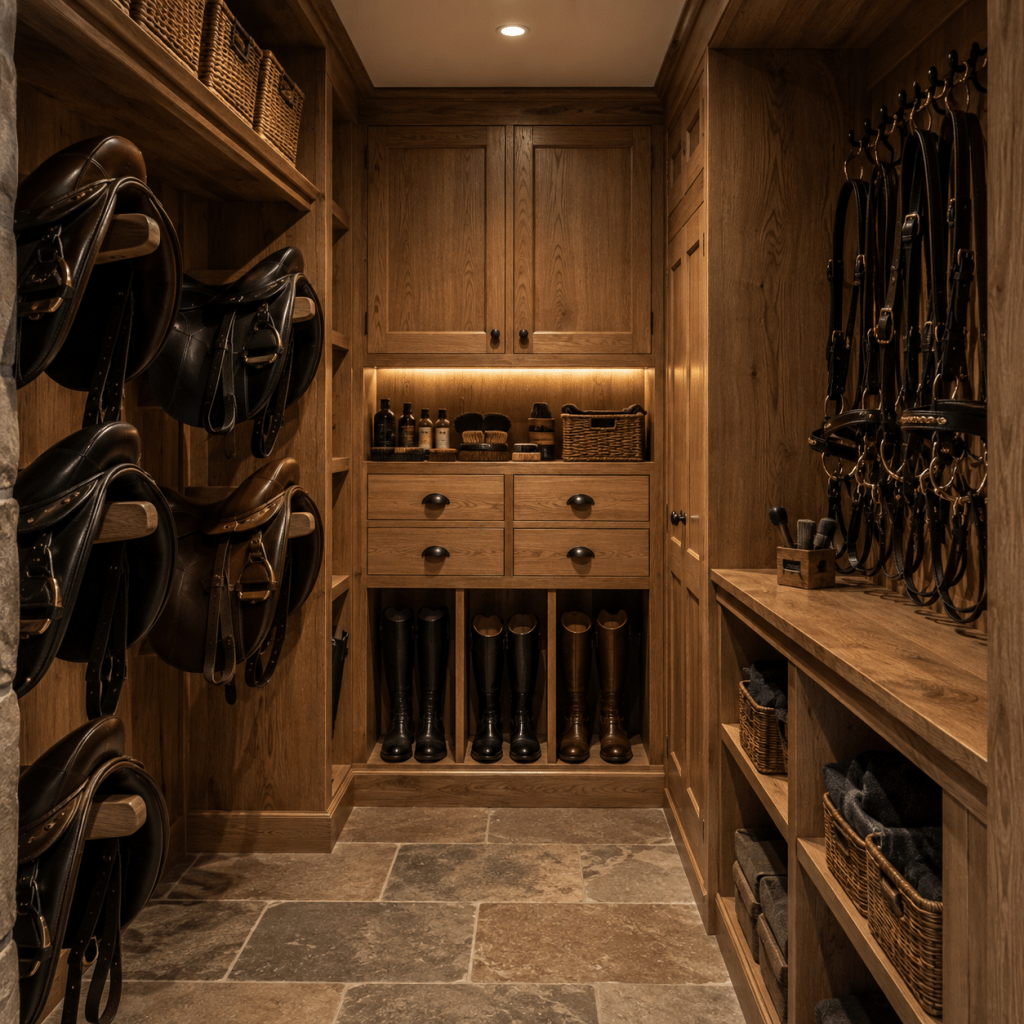
If you’re comparing options for alcove cupboards, shelves or integrated storage, our bespoke furniture cost calculator gives a useful budget starting point.
The tack room itself should form part of the storage plan.
Leather equipment, metal fittings, boots and other equestrian items may all spend long periods in the room, so ventilation and the general condition of the space should be considered alongside the cabinetry.
Archer Furniture’s tack-room storage guidance highlights ventilation and ventilated cabinetry as considerations that can be incorporated when planning an equestrian storage scheme.
Rather than treating those details as an afterthought, include them in the room-planning conversation from the start.
Some tack and riding equipment represents a considerable investment.
If security is important for your particular stable or property, think about which items should remain openly accessible and which might be better suited to enclosed or lockable storage.
Again, this is easier to address at the planning stage than after every available wall has already been assigned another purpose.
A good tack room should work for the way the space is used now without becoming unnecessarily rigid.
Adjustable shelving, sensible spare capacity and storage that is not designed around only one very specific item can make the room easier to adapt over time.
This is particularly worth considering in shared tack rooms, family equestrian properties or stable yards where the number and type of items being stored may change.
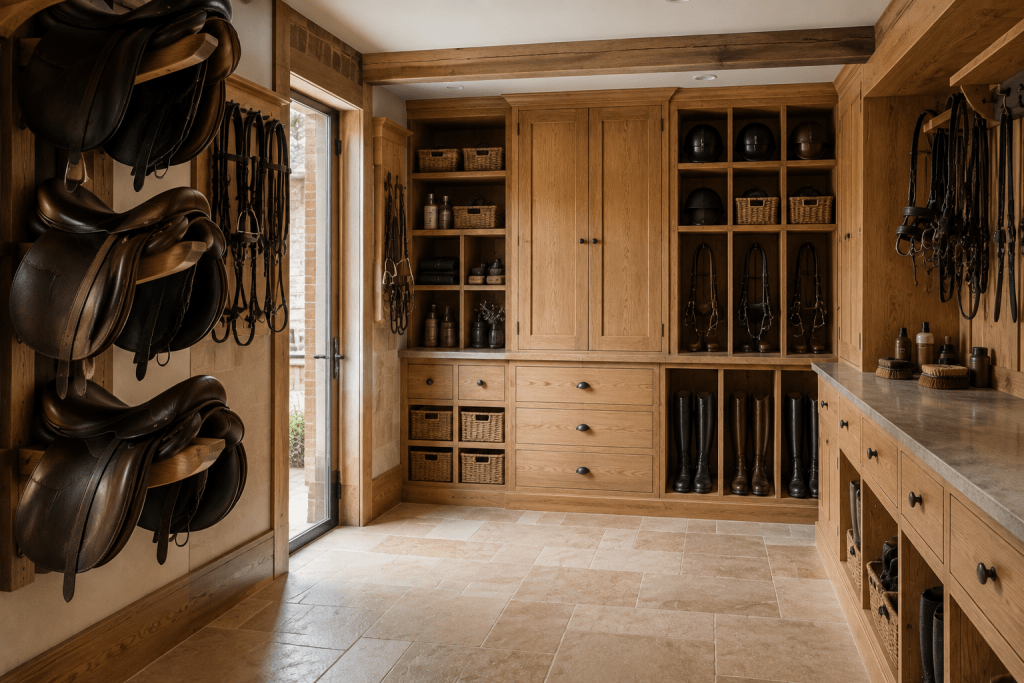
Not every part of a tack room needs to be custom-made.
The useful question is where made-to-measure furniture solves a problem that standard storage does not.
That may be:
Archer Furniture can design made-to-measure tack-room cabinetry and equestrian storage around the individual room, the equipment that needs to be stored and the client’s preferred layout.
Before commissioning new storage, ask:
Answering those questions first makes the furniture-design stage much easier.
If your tack room needs something more considered than standard freestanding storage, explore Archer Furniture’s Custom Oak Tack Room Storage page to see examples of the types of storage features, layouts and design options that can be incorporated into a made-to-measure scheme.
If you are also trying to establish a broader starting budget for bespoke fitted furniture, Archer Furniture’s bespoke furniture cost calculator provides guide estimates for several common project types. It is not currently a dedicated tack-room estimator, so a specific equestrian project would still need to be discussed individually.
Ready to transform your alcoves into a statement of design and craftsmanship?
Get in touch today to discuss your project or arrange a design consultation.
📞 07941 177969
✉️ info@archerfurniture.co.uk
If you have a project in mind and you would like to discuss how we can help, fill in your details below and we will call you back as soon as possible…